
New communications channels always look like an opportunity. The effect is only multiplied if you see someone else winning there, and then maybe you read some case study that makes it sound obvious and you think, “I have got to get on TikTok,” or the radio, or whatever else.
So you jump in and add a new communications channel for your business. And maybe another, and another. Suddenly you’re busy everywhere, but your consistent messaging has flown out the window.
A channel by itself is not a strategy; it just delivers what you want to tell people. If your intent with this messaging isn’t clear, it won’t do anything for you.
A channel fails because a business expects it to do the wrong job, and this is where I’d like to point to the research of Les Binet and Peter Field. After studying decades of data across hundreds of companies, they found a very interesting consistency:
Marketing works best when businesses balance two very different jobs: brand building and sales activation.
Not all channels are designed to do both, and you can get into a little trouble as a business owner when you don’t know which job you’re asking a channel to do.
Brand building is about memory, familiarity, and trust.
It works quietly and slowly over time, and its job is to make your business feel known before it’s needed.
Brand building answers questions customers aren’t consciously asking yet. Examples: Who feels safe? Which company do I recognize? Which company have I heard before?
Channels that suit brand building tend to reward repetition and consistency as well as a good emotional tone, and work best when you show up the same way for a long time.
Sales activation, on the other hand, is about action, and captures demand that already exists. It works fast, and it’s often measurable in the short term. For activation the customer is asking: Who can help me right now?
Many digital channels are very good at this.
The mistake businesses sometimes make is when they expect activation channels to build trust, or brand channels to drive immediate response.
Channels aren’t exactly underperforming when that’s happening; they’re just not being used for their best purpose.
A channel designed to increase a customer base’s collective memory of a business will feel inefficient if you judge it by its impact on immediate response, while a channel designed to capture urgency in the customer base will feel inefficient if you expect it to create long-term loyalty.
See what I mean?
This is why so many businesses feel like nothing works.
They keep switching channels instead of clarifying purpose.
They chase what looks active and abandon what looks slow.
But slowness is not failure when all you want to do is make the public more familiar with you.
Binet and Field’s work showed that the strongest, healthiest businesses don’t bet everything on short-term activation — they try to strike a balance between that and brand building.
Roughly 60% of their marketing budget is on sustained investment in brand building to keep the business mentally available in the minds of the customer base. This is complemented by short-term activation to capture demand when it surfaces, with around 40% of budget.
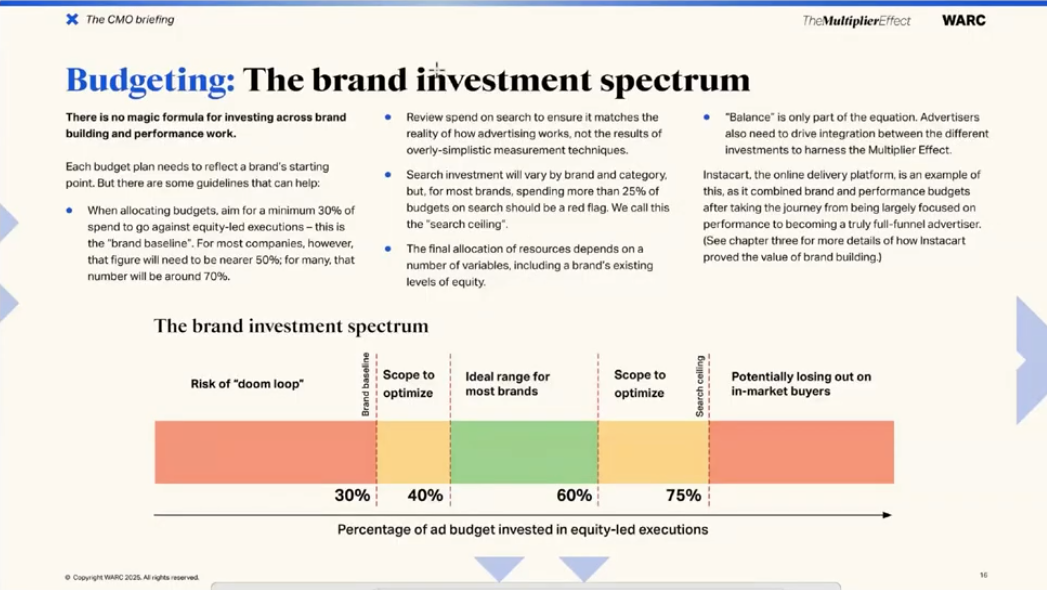
Allocating less than 30% of your marketing budget to brand building puts your business at risk of a doom loop where rising costs and shrinking returns compound until growth stalls entirely.
A balance like this can help make your business more stable. When you focus on brand building, activation costs less, conversions feel easier, and customers take less time to trust you. Without brand building, sales feel harder and any channel you’re working with feels expensive, while results become fragile.
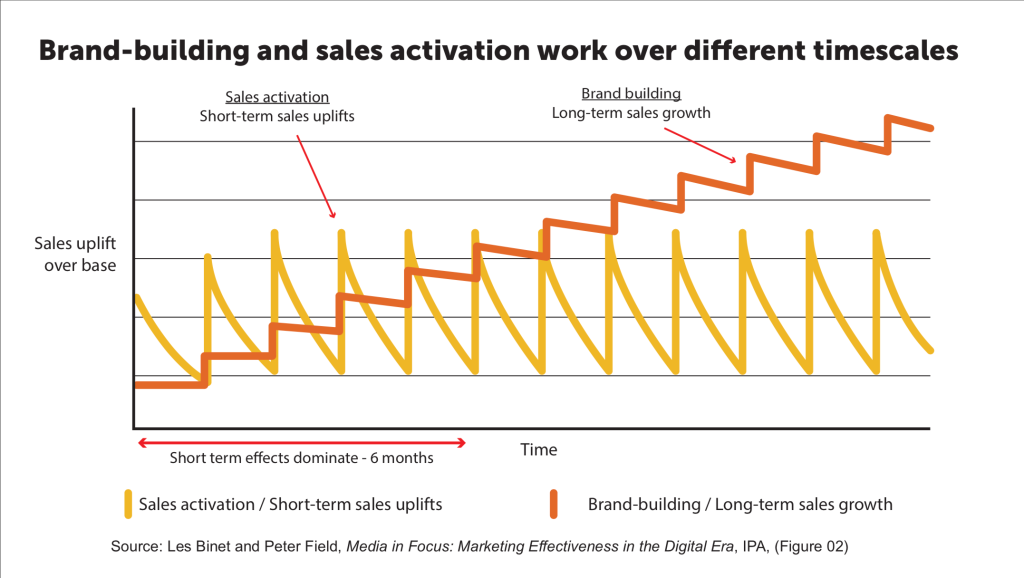
Businesses that rely only on short-term promotional tactics get sales spikes that vanish the moment they stop spending; brand building raises the sales floor permanently over time.
This is where owners often misdiagnose the problem.
They think they need a new channel, but what they really need a lot of the time is just patience with the right one.
Before pursuing any new channel, the most important question is this:
“What job are we hiring this channel to do?”
After you have this answered, also ask if the channel rewards repetition or novelty, and try to determine if you can use it consistently for years or not. Does the channel, additionally, help build your business in the memory of the public? Or does it capture any urgency?
And finally, are we willing to protect this channel even when it feels boring?
Consistency often feels boring on the inside, but you just have to fight through that.
The real cost of a new channel goes beyond money: what you really need to be thinking about is the attention it takes away from your efforts on other projects that might be more important. Every new communication channel for your business siphons away concentration you might have elsewhere. And every new channel saps at your ability to repeat specific marketing points. When you have trouble repeating yourself to your public, they’ll have trouble forming a feeling of trust with you.
Consistency beats presence everywhere.
Being everywhere briefly creates noise, while being somewhere consistently creates recognition.
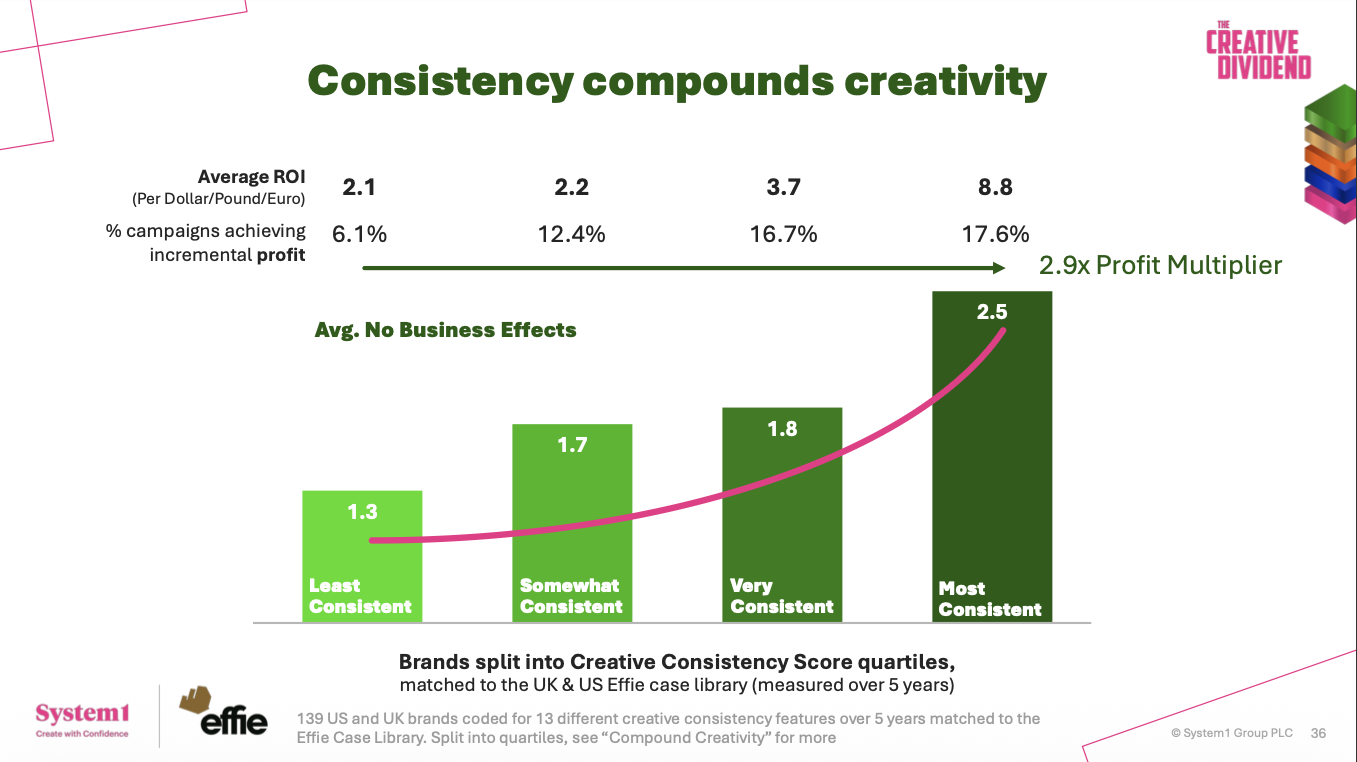
Businesses that commit to consistency in how they show up generate 8.8x the return on their marketing versus businesses that keep changing their approach — tracked across 139 companies over five years.
The right channel is the one you’re willing to commit to long-term because it aligns with the job you need done, and if you can’t imagine repeating the same core message there for years, it’s probably better not to start. Staying focused is how you build trust, and trust is what makes every channel work better — including the next one you’ll eventually add.
Wanting to grow and debating about adding a new channel?
I treasure entrepreneurs who are truly committed to the undertaking. Since you invested the time to finish this to the end, I want to meet that with some attention of my own.
I usually offer a deep 2-hour 1:1 deep coaching session for $1k but will give you the session for free as a reader of this article. Book your Coaching Call here.