I’ve met more than a few business owners who weren’t trying to master marketing as much as they were trying to stop wasting money. They needed to know which half of their marketing budget was actually helping their business, and which half just felt like it was helping.
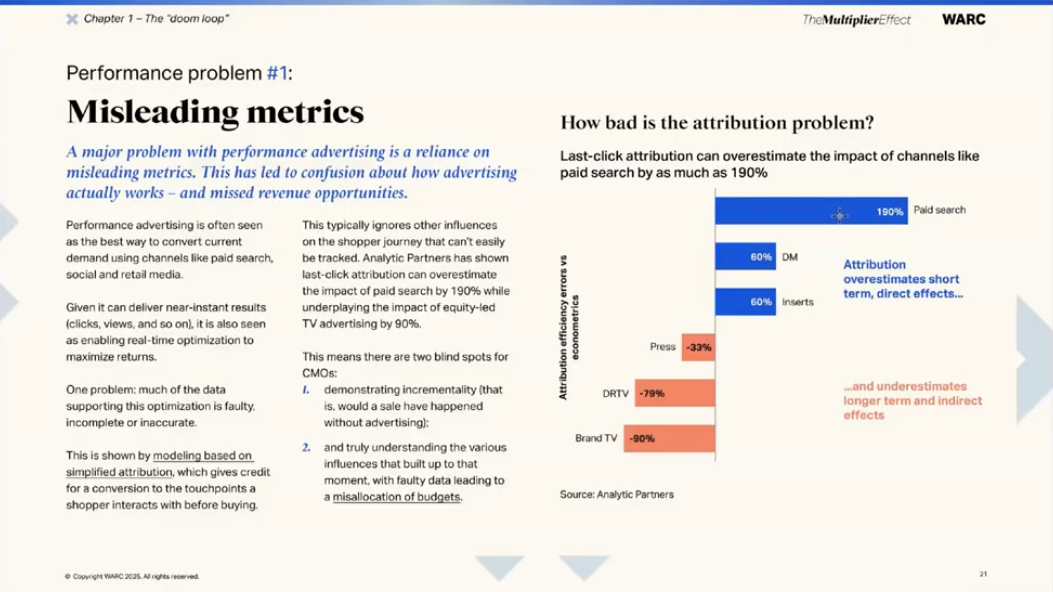
Standard digital tracking makes Google ads look up to 190% more effective than they actually are — while making brand advertising look 90% less effective — causing most businesses to unknowingly overspend on the wrong things.
This is where the digital-ads-versus-offline-ads debate comes in, and becomes a little confusing. But let’s define what we’re talking about before we move on, because owners themselves haven’t often been given good definitions.
Digital marketing is anything people encounter on a screen: search ads, social media ads, online video, e-mails, websites.
Offline marketing is everything people experience away from a screen: radio, direct mail, TV, billboards, sponsorships, print, community presence—anything that shows up in the physical world.
It’s not that one is better than the other; they just do different jobs, and one can’t effectively do the work of the other.
This is where the research from Les Binet and Peter Field becomes useful. After studying hundreds of businesses across decades, they found a remarkable consistency:
Those sound like byzantine marketing terms, but they’re not complicated.
Brand-building is everything that makes people remember you, recognize you, and feel familiar with you before they need what you offer. It takes a while to build up, and offline channels often shine here because they can create memory through repetition and consistent emotion, as well as presence.
Sales activation is everything that pushes someone to act now. Examples include search ads, promotions, urgent offers, and so on. Digital channels are very good at this.
The problem business owners have is when they want short-term sales activation to carry the full (and prolonged) weight of growth. A few things can happen at that point: costs can go up, results can start to feel oddly fragile, and the business might feel like it has to “feed the machine” constantly.
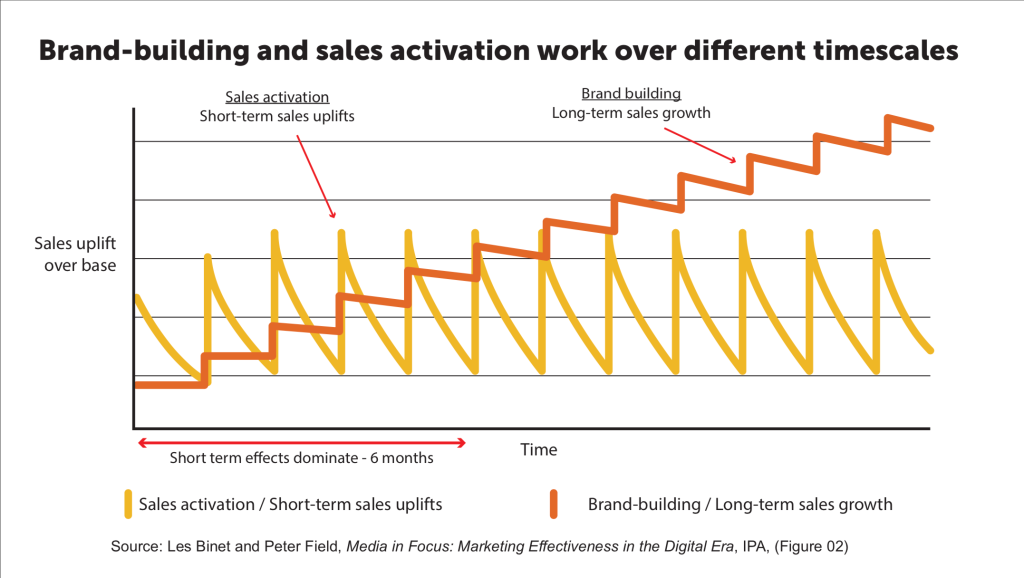
Promotional advertising produces sales spikes that disappear the moment you stop spending; brand building raises your sales floor permanently — the difference compounds significantly over time.
That’s because sales activation works best when people already know who you are… which happens when you’ve been doing brand-building in the background with offline ads.
Customers need stories, and those don’t get built in a few clicks and banner-ad impressions.
I’ve seen businesses that were “doing everything right” digitally—great targeting and optimization—and still felt invisible in their own market.
They were easy to find, but hard to remember.
That’s what offline marketing often fixes. You find it where life actually happens. On the radio on your way to work or with the kids, for example. Or on the sign by the highway, or on the backs of your community soccer team. And so on.
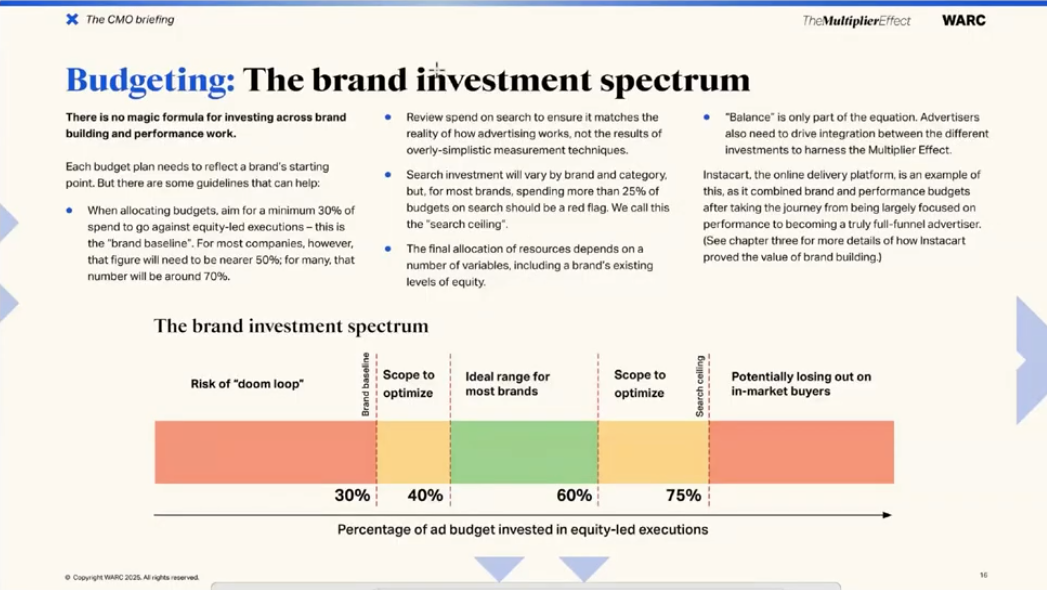
So what’s the right mix? The right mix is the one that lets customers recognize you before they need you, and trust you when they finally do, which research shows is around 60% focused on building your brand and 40% on activating people.
Spending less than 30% of your marketing budget on brand building puts your business at risk of a doom loop — where rising ad costs and shrinking returns feed on each other until growth stalls entirely.
If you can manage this, marketing will stop feeling so expensive and become more stable.
Most small businesses spend less than 20% of their marketing budget on building their brand. If you want guidance on easing into the right balance for your business or reaching your growth goals more generally, I offer a deep 2-hour 1:1 coaching session for $1k.
Since you invested your time to read this to the end, I want meet that with time of my own. If you follow this link, I’ll waive the fee for the first coaching session.